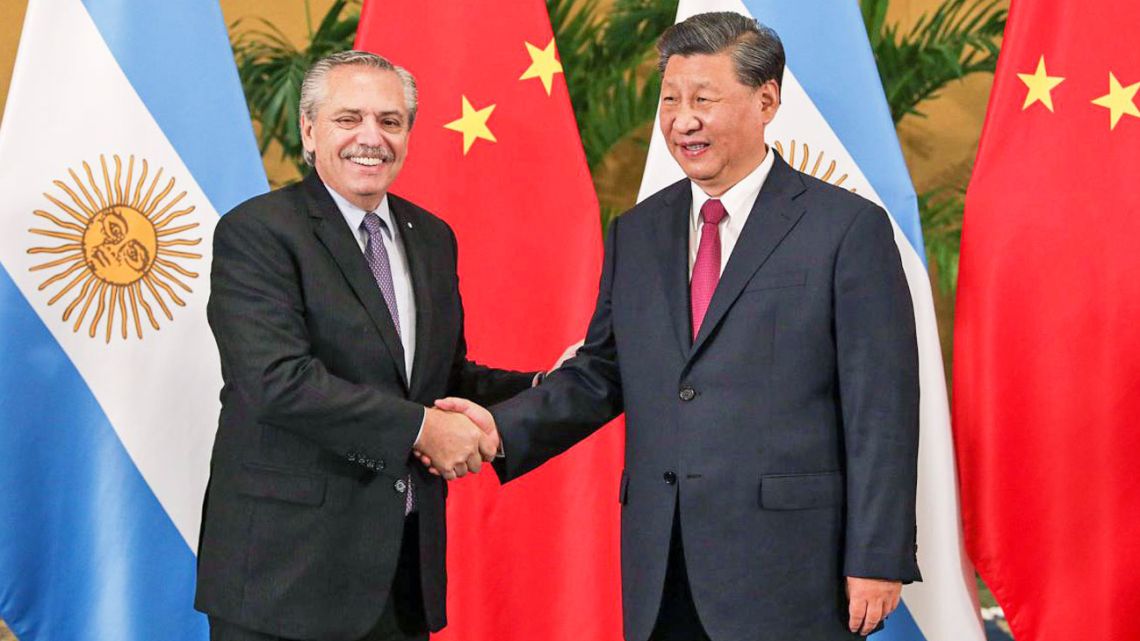


Alberto Fernández enters the final stretch of his term and, among the many failures accumulated after these three years, is the failed diplomacy against China. There are plenty of arguments to argue that Fernández lacked a coherent and consistent foreign policy. Kirchner’s diplomacy has been characterized rather by improvisation, a marked ideological bias and permanent oscillations in relations with third countries (the cases of the US and Russia, to mention just two examples). Within this framework, the strategic relationship with China also foundered, today in a state of virtual stagnation, very negative for both parties.
From the very beginning of his term, Fernández made great promises to China that have not yet materialized. The President even traveled to Beijing in February 2022 and joined the controversial Belt and Road Initiative, signing twenty memoranda riddled with grandiose projects, for more than US$23 billion. Many of these projects are not new, since they have been dragging on Sino-Argentine relations for a decade.
Truncated projects. The list of Argentine breaches (frustrations from the Chinese point of view) is very long. The most paradigmatic case is that of the Atucha III nuclear power plant, whose first appearance on the short list of projects that China would finance in Argentina occurred in 2014, during an official visit by Cristina Kirchner to Xi Jinping. In fact, the former president herself publicized it as an achievement on her personal website. The now imprisoned and then Federal Planning Minister, Julio De Vido, had been put in charge of the negotiations with the China National Nuclear Corporation (CNNC), whose main interest was in making its Hualong One technology work outside of China.
The nuclear power plant project, whose Argentine counterpart is the state company Nucleoeléctrica SA, did not make concrete progress during the second term of Cristina Fernández de Kirchner, nor during the presidency of Mauricio Macri, who twice reneged on the agreement. Yes, memorandums, cooperation agreements and even some commercial contract expired due to lack of financing were signed, as in almost all the projects that did not get to start.
As for infrastructure, there are dozens of other projects that have been cut short. Several also date back to Cristina Fernández de Kirchner’s first visits to China and have tried to be revived by the government of Alberto Fernández. Cases such as the Chaco-Corrientes Bridge, the Vaca Muerta gas pipeline, the Manuel Belgrano II thermoelectric power plant, AySA’s Río Subterráneo Sur, the Tierra del Fuego logistics pole, dredging, high-voltage electrical connections and improvements to railway branches stand out. .
To this we must add the halt in central works that already have Chinese financing, such as the Santa Cruz dams, China’s most important infrastructure work in Argentina. A recent Chinese disbursement of US$ 212 million tried to give a new line of life to this project, which has been plagued by systematic defaults in Argentine payments, structural problems, lawsuits and union crises, among other things, from 2013 to date. It took a decade for the first turbine of the project to arrive in Argentina, which should have been completed by 2019. If it is completed one day, another chapter in this intricate story will be the more than 3,000 kilometers of extra-high voltage lines necessary to connect the dams with the main electricity consumption nodes.
Another sector loaded with frustrations and projects that never came to fruition is the oil sector. At a time when Vaca Muerta is presented, even by the government itself, as the goose that lays the golden eggs, China has gone out of business. First was the departure of Sinopec from Argentina in 2020, after suffering severe union conflicts in Santa Cruz. And then we would have to count infrastructure works such as gas pipelines and liquefaction plants that were left in nothing. The space that China hoped to occupy, both in production and construction, with companies like PowerChina at the helm, seems to not exist for now.
But not only in infrastructure and energy there were drawbacks in the relationship. To mention other of the most paradigmatic cases, in terms of central issues on the bilateral agenda that did not materialize or were not resolved: the pig agreement, the purchase of JF-17 fighter planes, the problem of illegal fishing in the Argentine Sea by Chinese vessels and the activation of the bilateral treaty to eliminate double taxation, signed by both parties in 2018. These are just some of the main pending issues.
militant diplomacy. Meanwhile, China has unusually had two ambassadors at its service in relation to Argentina: on the one hand, the official designated by the Chinese Foreign Ministry, Zou Xiaoli. On the other, the unofficial, the Argentine Sabino Vaca Narvaja, who, fascinated by Chinese politics and culture, lost dimension of the nature of his charge and often ended up representing Chinese interests rather than those of his own country. Vaca Narvaja has perhaps been the most faithful product of the so-called “militant diplomacy”, exalted by President Fernández himself when he appointed him in 2020.
The balance for Argentina of this failed foreign policy is very negative: important Chinese investments have been paralyzed or, at least, are not advancing at the expected pace, both in energy and in transport and telecommunications. Perhaps the only sector that has managed to take off in any significant way is mining, buoyed by growing interest in lithium from Chinese companies. In addition, we must highlight the expansion of the Caucharí solar park, in Jujuy. But not much else.
Since 2019, no new major financing agreements have been signed by Chinese banks in Argentina, something that is in line with China’s role in the region. Xi Jinping’s administration has veered away from his strategy toward Latin America. Since the covid-19 pandemic, it has only made progress in some key areas in countries with closer relationships, as shown by mergers and acquisitions in energy companies in Chile (with whom they have signed an FTA) and Brazil (with whom they share the Brics ).
The Argentine government seems not to account for the geopolitical paradigm shift that the covid and Russia’s invasion of Ukraine implied, especially with regard to the energy issue, food security and in terms of defense, and what that implies for the relationship with China and other global powers.
Growing trade deficit. While Chinese investment stagnates (actually financing, because there are few cases of direct investment by Chinese companies in Argentina), the trade deficit continues to grow. The government of Mauricio Macri will reduce this chronic deficit in the relationship with China to US$2,441 million in 2019 fines, while the government of Alberto Fernández is returning it to record levels above US$9 billion in 2022. And What is worse, the commercial volume does not increase: it has been stabilized for almost two decades, with little diversification and enormous squandered opportunities. In 2020, the absurdity of closing meat exports to try to curb inflation was even reached.
Foreign Minister Santiago Cafiero, in his most recent communication with his new Chinese counterpart, Qin Gang, “emphasized the importance of promoting a more balanced and diversified bilateral trade, and also stressed the need to expedite the processes of opening markets for products Argentines”, according to the official statement. Of course, Cafiero avoided referring to the productive reprincipalization that our sale of soybeans to China means (it is still the main export product), compared to the sale of oils and pellets to India and the Asean countries, for example. On the other hand, Argentine products, beyond the opening of markets, have problems competing in the global market, mainly due to internal economic and financial restrictions and, in addition, due to the scarcity of trade agreements that Argentina has signed. In this sense, Fernández has already made clear his opposition to the possible Mercosur-China agreement.
Finally, you have to add the currency swap. Actually, this “exchange” is not such from the perspective of a country that does not have a currency, such as Argentina. The swap is nothing more than a sovereign loan from China in yuan, convertible to dollars at a high financial cost. In fact, the swap was renewed and has just been increased by some US$ 5 billion, with the aggravating circumstance that China granted Minister Sergio Massa the guarantee to freely use this increase by operating in the foreign exchange market. In total, the swap is already around US$23 billion.
Is this all China’s fault? Clearly not. Argentina has become one of the most closed economies in the world, with an absolutely hostile context for production, foreign investment and foreign trade in general, regardless of which country it is.
For its part, China appears to have unlimited reserves of “oriental patience” in dealing with Argentina. There continue to be friendly gestures from China, both political and economic. Surely, with the aim of trying to keep afloat one of Beijing’s most transcendent, but also most complicated relationships in Latin America. And, most likely, already with an eye on beyond December of this year.
*Executive Director of the Sino Argentino Observatory.
** Founder of Reporte Asia.
You may also like