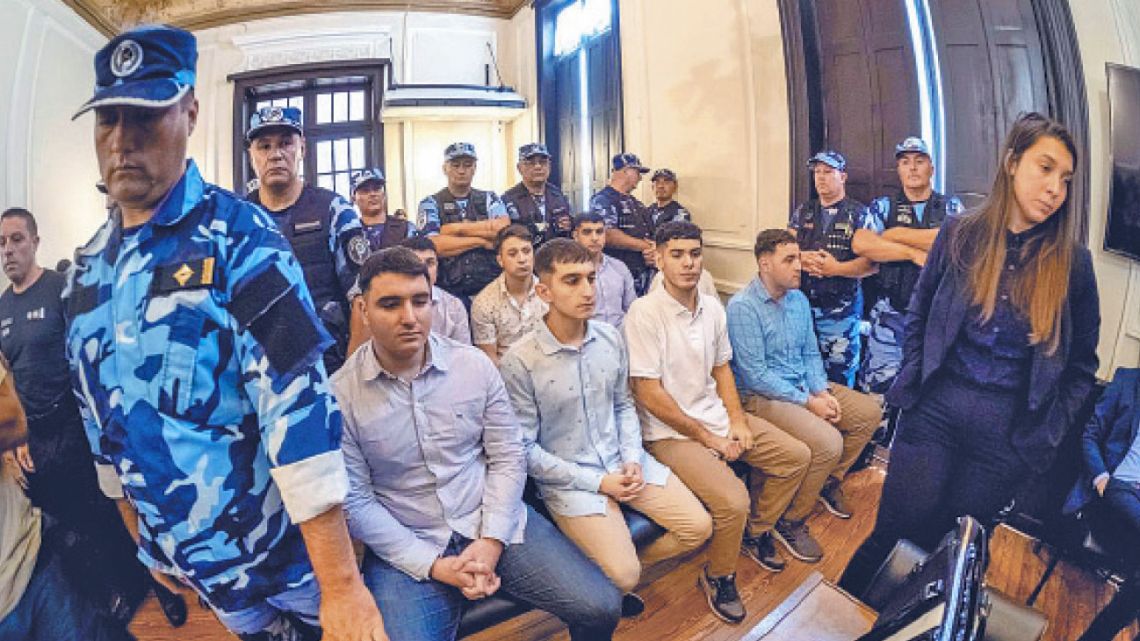


On Monday, February 6, thousands of Argentines woke up longing for the arrival of the moment for which they had waited so long, that of the sentencing for the crime of the young Fernando Baéz Sosa and a group of young people like him. For days and months, the media, almost without exception, focused on the case, helping to build a sentence that was finally announced by the court at the established time.
And the vast majority of social networks and communicators turned out like an army to celebrate the victory over the life sentence sentence, as if that sentence had been the only one that could be applied to this case and no other. A celebration accompanied by extreme expressions towards the condemned as if the ruling were not enough if the necessary and infinite dose of suffering was not met.
The truth is that this case embodies, like so many others, a social tragedy of dimensions that spill over to one side and the other of the crime scene: on one side, the parents who have seen their only son die in a savage and cruel, on the other, eight young people and eight families for which, from this moment on, everything will be tinged with anguish. Who can happily celebrate the sentence to life imprisonment, seeing his fellow man sentenced to live in darkness and imprisonment for the rest of his life? What is the soul of someone who rejoices over the punishment and humiliation that the condemned will have to suffer once he enters prison? Does confessing that we can become companions through this tragic destiny make us moral accomplices of the crime?
Faced with a brutal act like the one that cost Fernando Baéz Sosa his life, there is only one possibility of claiming, that the Justice dictates its sentence with equanimity, that there is no impunity, as before any other crime. Everything else, the celebration, the rejoicing, the public humiliation of the damned, their classification as monsters or detritus, the desire that their lives are henceforth lived in the worst of the underworlds only reveals a dimension of contempt for the human dignity of the person who enunciates it similar to that of those who committed the crime.
We live in violent societies. One of the ways to ward off this violence is to demand the rule of Justice, if we add the desire for revenge to that claim, our just claim is degraded and debased. Violent death is or should be a scandal, always. We must not naturalize her, ever, and we are ethically obliged to work tirelessly to expel her from our environment, limiting the possibility that she shows her face among us. Something different is the cruelty on the bodies of the vanquished, unloading on them our social impotence, our frustrations, making those bodies, those lives, the only territory where absolute evil would supposedly express itself.
But this is not the answer that the human species always gives. The writer Emanuele Carrere dedicated himself to covering the trial that took place in Paris for the terrorist attack in the Bataclan bar where dozens of young people were machine-gunned to death. In a session of that trial he had to compare himself with Azdyne Amimour, father of the terrorist who committed that barbarity, a man morally defeated by his awareness of being the father of a murderer. Carrere then recounts a scene that for many may be unbearable, and that is that some time later, Georges Salines, whose daughter Lola was murdered in the Bataclan, received a letter from the terrorist’s father that said: “I want to talk to you about this tragic event because I also feel like a victim because of my son.” Carrere says that this request perplexed the father of the murdered young woman, but that they finally received it and that since then they began to engage in a dialogue that finally resulted in a book. Carrere says that when reading that dialogue one wonders: “isn’t it even more terrible to have a murderous son than a murdered daughter?” Carrere does not answer, he leaves the question open, he throws it provocatively at the readers, knowing that there is not a single answer to that disturbing question that is at the center of that human tragedy that runs through the hearts of these two parents and that is not resolved in the mere idea of punishment, because there can always be something else to help us face the irreparable.
We must know it, violent death splinters and pulverizes the ideal of coexistence. Every time it happens it takes us back in what the species has barely learned throughout history, returning us to that mythical and primordial scene in which Cain snatches the life of his own brother Abel.
Violent death takes the life of the murdered but that of the murderer is marked, impoverished and debased forever for having broken with his act the essential pact that living together implies.
The sentence has already been handed down, and those responsible for the crime have heard the voice of the Court, their sentence, and their parents know, although they are reluctant to accept it, that from now on nothing, absolutely nothing will ever be the same, that their lives will be trapped as in a sinister web by the memory of the crime committed by their children. What more condemnation than that, what more suffering can be wished for them than this atrocious evidence, that dark memory that will spur their dreams from now until the end of their days?
There should never be room for rejoicing at any unfortunate fate, for anyone, ever, in any case.
Because if there is rejoicing, there is a desire for revenge. And revenge, we know, has nothing to do, absolutely nothing, with the just and necessary demand for Justice.
*Professor in Literature at the UNR, where he gives the annual Seminar on Memory and Human Rights.
Director of the International Museum for Democracy and Academic Advisor of Cadal.
You may also like