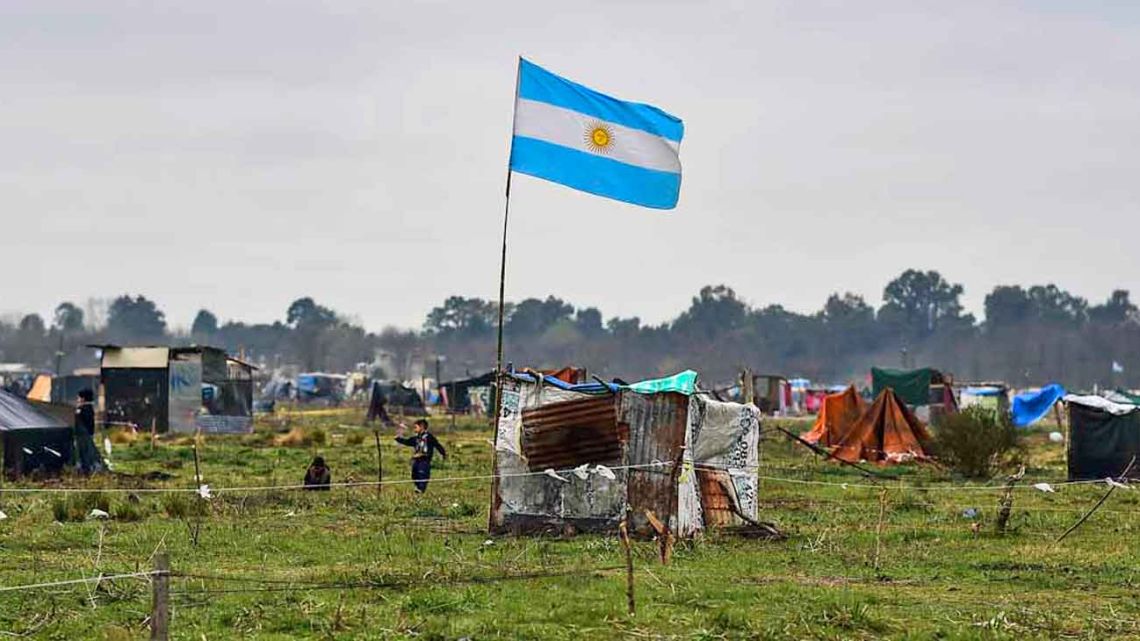


Housing and territorial development policies are positive initiatives of the current administration. Without forgetting that these are, in part, the result of a broader popular struggle embodied in the so-called taking of Guernica, when more than two thousand families from different Buenos Aires districts took over two hundred hectares of land in the Presidente Perón district, province from Buenos Aires. The particularity of these shots lay in the profile of these families: women with children, victims of gender violence and/or the unemployed without the possibility of paying rent.
These events, carried out by very vulnerable sectors of society, led to changes in the political arena, on the one hand, and the use of new habitat initiatives, on the other. Since then, housing policies have been supported by the Argentine Credit Program (Procrear), and express a virtuous and collaborative design between different public-private entities: the State, the Mortgage Bank, and the community. This marks an important difference with other housing experiences globally, which are characterized by introducing positive incentives to the private market (USA), negative incentives to the rental offer (Germany, the Netherlands, Nordic countries) or quotas for the construction of social housing, whose paradigmatic case is the city of Barcelona.
Procrear acquires unprecedented visibility due to its social nature, scale and its promotion of the construction sector in the territories. Since 2020, its design aims for families to achieve the dream of “their own home”, with amounts that were initially attractive for its execution: four million pesos. These maximum amounts were offered in 2020, 2021 and 2022 with segmented disbursements in a maximum term of twelve months under a three-figure inflationary context. In those times, construction began with a cumulative increase of 48.5% by 2021 (Indec, 2022). Added to this are the increases in 2022, when the works are carried out for those who were drawn in 2021 and 2022, with a cumulative 71% according to the same data source. Only this last inflationary fact implied a purchasing loss of more than 70% on the 4.3 million granted by the program.
The course of any public policy is determined not only by its design but also (and above all) by its context and implementation conditions. This means that, no matter how good and virtuous the plans and intentions of the rulers are, when the policies are put into action they change, and therefore their purposes are transmuted or modified and differ from the initial purpose. This applies to any public policy at the global level and the Procrear program is not only no exception, but rather a paradigmatic case of analysis of how great expectations conceived at the national level are frustrated in their implementation due to unresolved context conditions.
Today, the beneficiaries of Procrear 2021 and 2022 are demanding the pulverization of the credits due to rising inflation and other unforeseen context factors, namely: delays –in some cases from one year to the next– for the total disbursement of the credit, the times typical of the management of work permits and the particularities of the quota adjustment system under a new Home formula that allows the quotas to be increased according to salary, but not to request new loans under that rate.
The testimonies reveal that these problems are solved by the beneficiaries with new debts at rates of 300%, revealing a financial suffocation to more than eight hundred families that pay various credits and rents because they have not closed their houses. Therefore, they request a complementary credit. These implementation failures, reflected in the impoverishment of families and new unworthy living conditions, will seriously affect the social purpose for which Procrear was created.
Finally, the program reproduces the structural inequalities typical of Argentine federalism that makes Buenos Aires the center of the map. In the provinces, the absence of references where they express the problem, gave rise to forms of virtual organization to reach the central government.
These problems are not new. They were resolved before the devaluation of 2016 and 2020 with compensatory credits. If the policy intends to have an effective impact and change the vertex of the public agenda, it is necessary to close the gap generated and create conditions of equity between beneficiaries and future participants.
*Doctor in Education and researcher at Conicet.
You may also like