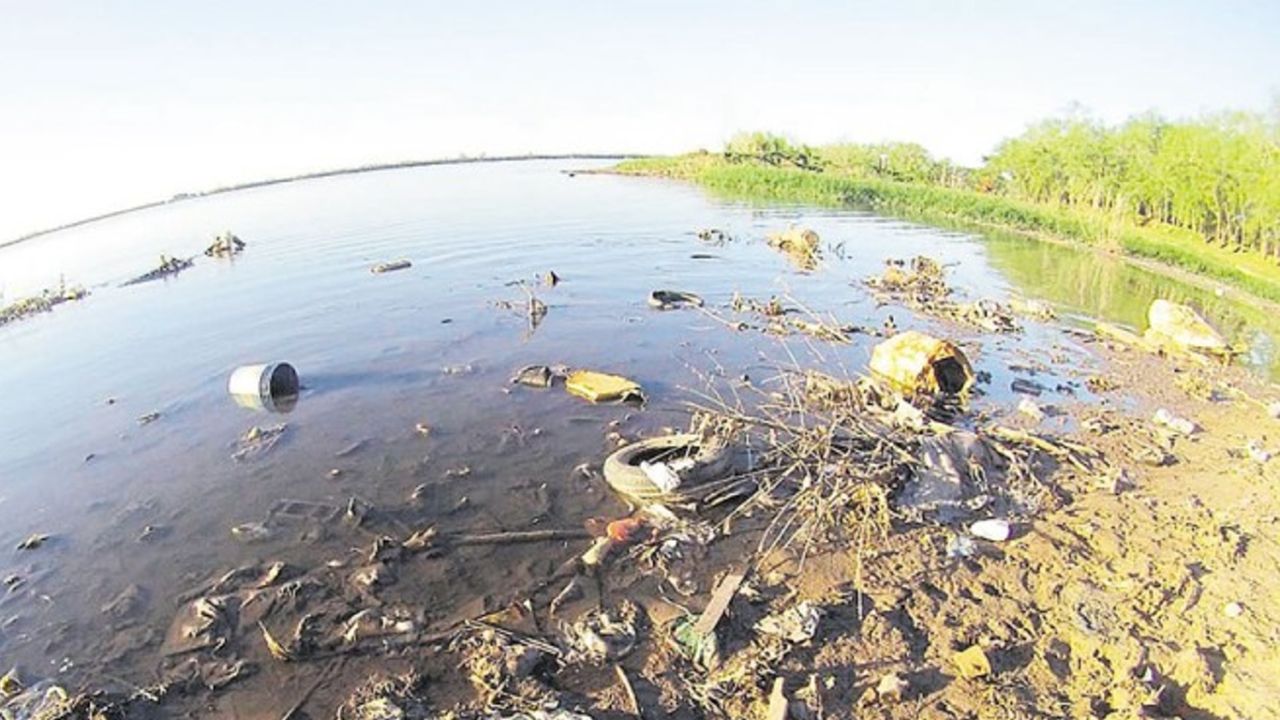

Birds and fish that inhabit the river region Medium Paraná ingest millimeter plastic particles that are so fragmented in their natural habitat that it is totally impossible to differentiate them, according to a recent study carried out by a team of specialists from the National Institute of Limnology -INALI, CONICET-Universidad Nacional del Litoral
During the study, the scientists found a worryingly large number of microparticles in the viscera of fish as well as in the feces of native birds, among which is the thornbush greatone of the most typical species of the Argentine coast.
Although the team made the first measurements in the year 2016 with the aim of trying detect microplastics in the Thompson Spa, one of the most famous in the city of Paraná, Entre Ríos, where they found close to 5,000 units per square meter of small plastic particles smaller than 5 millimeters-, then they decided to expand to the area of the Middle Paranáto establish how far the contamination of birds and fish due to the consumption of plastics and excellent were the environmental consequences caused by this phenomenon.

“It was an elephant that was there in the middle of the room. Everyone saw it, but on a scientific level It had not been studied here in Argentina or in Latin America” commentary, Martin BletllerPhD in Biological Sciences and one of the program’s researchers, in an interview with the DiaryAR
“What was really striking and worrying was that already in the first sample we obtained, we detected the presence of microplastics in a huge number of birds and fish,” said the specialist.
In addition, the study affirms that in the region there is nothing less that an average of 220 containers of bottles, glasses and other plastics every 100 square meters, while thanks to the analysis of the microparticles the researchers registered 5,000 microparticles per square meter.
“The number of microparticles can be increased to 15 or 20,000, depending on the area where the study is carried out, among other variables.. On the Thompson beach, in Paraná, we found these amounts. It is a beach that is bordered upstream by the Las Viejas stream, a kind of large microplastic injector,” Blettler said.
In the specific case of fish, the study reveals that all tarpon studied in the Middle Paraná area were contaminated with at least one microplastic.

While, although the average of microparticles found in general in this species was 9.9 %, in one detected the presence of 27 microplastics, which powerfully caught the attention of the researchers.
For his part, 90% of the microplastics found in the knew they were fiberssomething that, according to Bletter, was also revealed by several international studies carried out in the last 5 years.
“Hay Many studies worldwide who reported higher number of ingested fibers compared to other types of microplastics. In the Argentina, Only 9% of plastic waste is recycled, the rest ends up in landfills, the river and then the sea, with all the risks that this implies for the environment”
“The streams play a role as if they were veins through which plastics are transferred to the river. After a rain or growing we see in the streams how some feathers that extend in the mouth that gives to the Paraná, the same as in each storm mouth, with a collection of plastics that goes out towards the river”, Concluded Blettler.