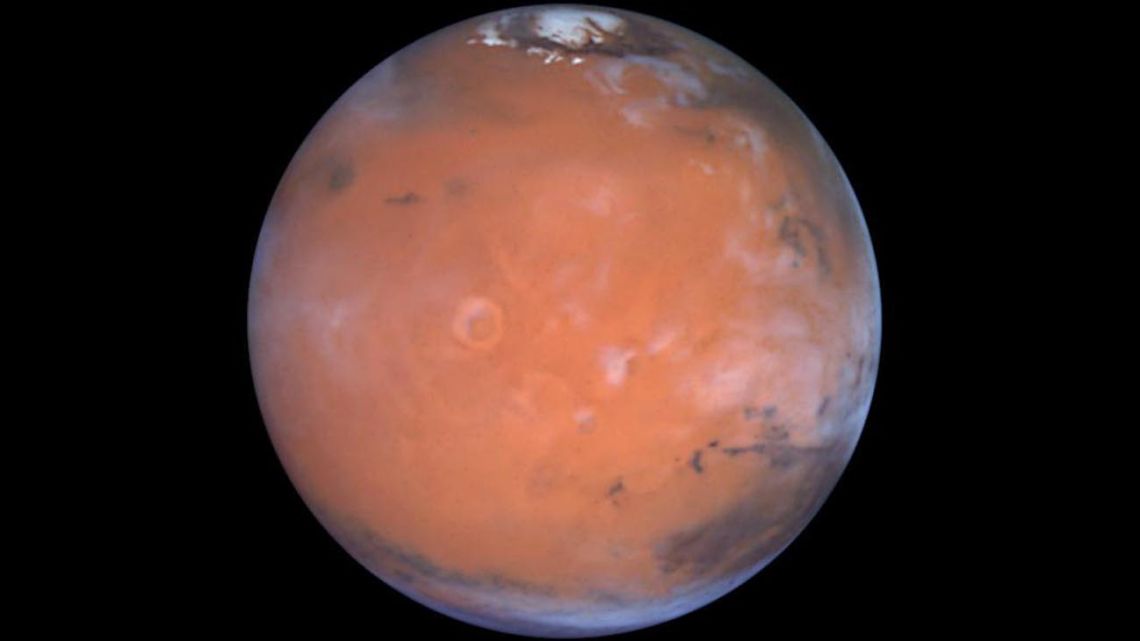

Experts from the Center for Astrobiology (CAB) studied an ancient river bed in the Atacama desert, Chile, to analyze the detection limits of life on Mars with the current state of technology. Despite scientific advances in recent decades, they concluded that finding remains of life on the red planet will be “difficult, if not impossible”.
The document, which was published in the journal nature communicationsless than current instruments for detecting life on Mars, and others soon to be sent, could not being sensitive enough to find traces of life on the red planet
A “bear” on Mars? The curious photo that NASA took on the red planet
“The stone (from the Atacama desert) matches that detected by terrestrial instruments on the red planet. Similarly, low levels of organic compounds will be difficult, if not impossible, to detect in Martian rocksaccording to the instrument and the technique used”, they detailed in the document.
The study was carried out by an international group of researchers, in which members of the CAB participated in collaboration with the Higher Council for Scientific Research and the National Institute of Aerospace Technology (INTA). The analysis was carried out in “Piedra Roja”, an analogue of Mars in the Atacama desert. The area is located in northern Chile and would be the remnant of an ancient fluvial delta that would have formed under arid conditions in the Jurassic period, more than 100 million years ago.

In this place, the researchers need that the landscape is formed by a variety of sediments interspersed with sandstones and own clays, which would confirm that it is a fluvial bed. Added to this, detect an abundant presence of hematitean oxide of iron found on Mars and gives it its characteristic red color.
This area shares geological similarities with Mars, specifically with the areas that NASA’s Perseverance rover is exploring. In addition, there were a variety of microorganisms difficult to classify, which they called “Dark Microbiome“. We also found different “biosignatures” (substances that can indicate the presence of life in a place), but at the detection limit of the instruments present in a research laboratory.
NASA emerged on Mars a meteorite crash that blew water through the air
“What was remarkable was that by using a variety of instruments that are on or soon to be on Mars, and depending on the biosignature you were looking for, several of these instruments can barely detect themor they were simply not capable of doing it”, points out Armando Azua-Bustos, a CSIC researcher in the Department of Planetology and Habitability of the CAB and co-author of the study.
According to the CAB, these demonstrations demonstrate the importance of bringing samples from Mars to Earth to be able to analyze them with the most powerful detection techniques available in laboratories. In this sense, NASA, the European Space Agency (ESA) and other institutions are working to carry out this task.
“It is very important to have terrestrial models as similar to Mars as possible to understand how the different biosignatures have been preserved and fine-tune the procedures and technology to find them”, said the researcher Víctor Parro, co-author of the work.
MB/MCP
You may also like