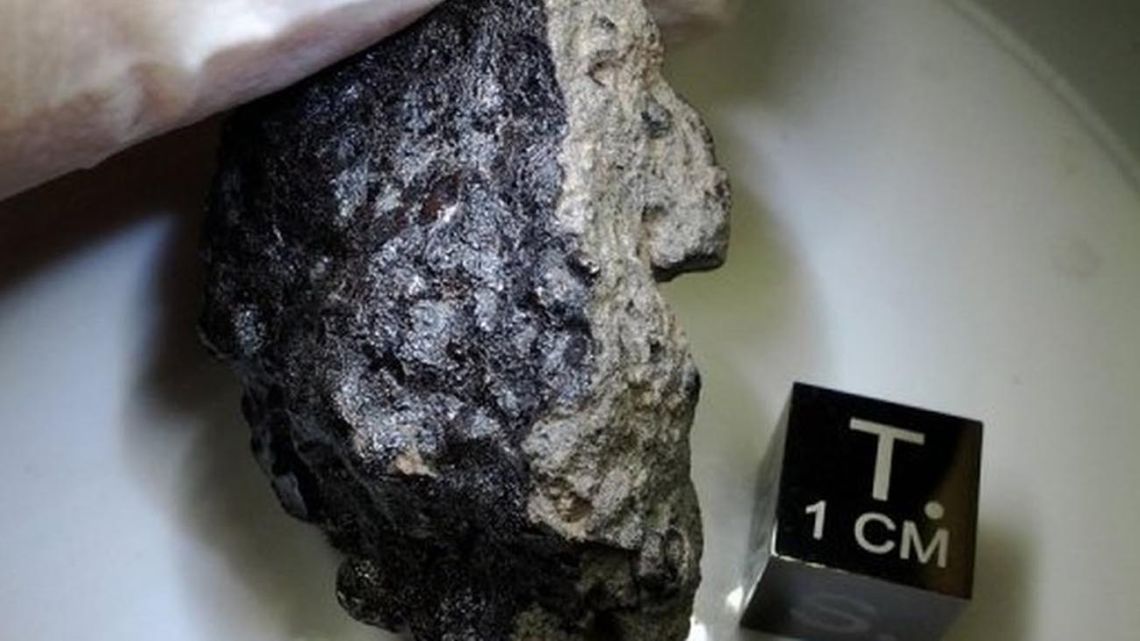

The Tissint meteorite was ejected from Mars more than 700,000 years ago and reached Earth in July 2011. The rock impacted in southern Morocco and, according to scientific investigations, could indicate the presence of extraterrestrial life.
The meteorite remains were analyzed and the results were published in the journal Progress of science. Based on what has been observed so far, the piece of rock contains previously unpublished organic compounds that could provide information about life on Mars since it originated there and it is one of the five rocks from that planet observed as they fell to Earth.

This meteorite contains, among its organic components, carbon, hydrogen, oxygen, nitrogen and sulfur which, in general, are associated with life forms. However, some research suggests that these rocks may be created by non-biological processes, known as abiotic organic chemistry.
For Philippe Schmitt-Kopplin, researcher and lead author of a study on the meteorite, “Mars and Earth share many aspects of their evolution.” “Although life arose and thrived on our home planet, the question of whether it ever existed on Mars is a very hot research topic that requires a deeper understanding of the water, organic molecules, and reactive surfaces of our neighboring planet.” explained.
Martian life? They discovered molten rock on Mars with ideal conditions for microbes
In addition, this meteorite constitutes “fresh material that was not contaminated by atmospheric agents”, according to Hasnaa Chennaoui, a scientific precision from Morocco, the country from which more than half of the asteroid fragments studied by science in the world come.
The content of the rock
The Tissint Meteorite It has the particularity of being the most complete of those that arrived from MarsThat is why the researchers put together a catalog of the organic compounds found in it and agreed a link between the diversity of organic molecules and their type with the specific mineralogy of a meteorite.
In the rock the main compound was magnesium in organic form, something that have not been seen before in samples from Mars, so they deduce that it could be useful to understand the geochemistry of high pressure and high temperature that shaped the deep interior of Mars.
According to the publication, the abundance of this type of organic magnesium compound could also point to a connection between the carbon cycle on Mars and the evolution of its minerals.
AS/ff
You may also like