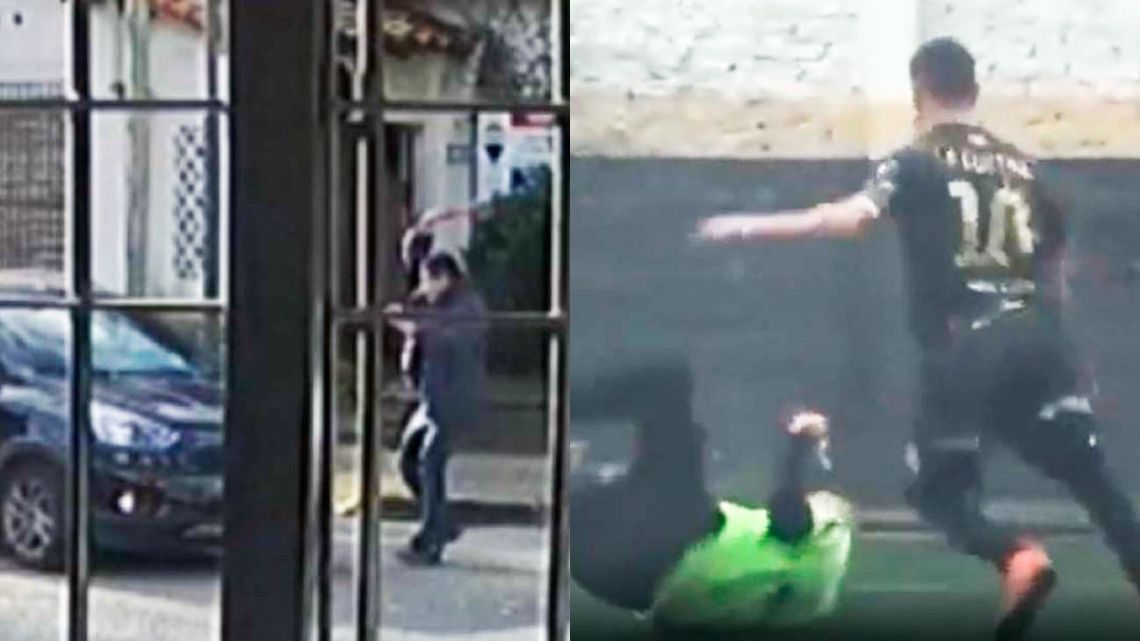


Although it is a crude fact and violentthe images that went viral on Friday of the driver who, after a collision with another vehicle, gets out and, without saying a word, breaks the car windshield with an ax, are not an exception, but rather the rule. This is what a recent survey that analyzes the characteristics of abuse on public roads suggests. And the first conclusion is very harsh: four out of ten relevant Argentines confirm having witnessed an act of abuse or aggression on public roads in the past thirty days.
“Making averages gave us that 41% of all those surveyed -Argentine adults, from all over the country- said they had witnessed some act of abuse or aggression that occurred on public roads, in the past thirty days before being surveyed,” he explained to PROFILE constance cilleydirector of the consultancy Voices!/Wade and coordinator of this social investigation. And she explained: “We undertook this research work because we perceived, from other surveys, that it is a topic that weighs more and more in the minds of the people. We also found that these cases are reflected, with increasing importance, in the media.” In addition, according to Cilley, in informal conversations “it emerged that it was an issue of increasing concern, especially those responsible for customer service: from a bank teller, to public transport drivers, to a nurse or doctor on duty.
This situation of violence on the verge of exploding is widespread, as demonstrated by the segmentation of the responses to the survey according to geographies, socioeconomic levels or gender of the respondents. Specifically, from the Voices! It can be seen that both men and women reported having witnessed this type of behavior in similar numbers, with 41% in each case.
When the data is opened by socioeconomic level, what was found is that the mistreatment and the assault almost equally to all social classes. Thus, for example, the high and medium segments ABC1 and C2C3 reported an incidence of 42%, while those in the lowest socioeconomic level (DE) showed a slightly lower proportion, with 35%. That does not mean that more than a third of this segment has witnessed violence in the past four weeks.
There are some more notable differences when the responses are examined by geographical area. Thus, in the Autonomous City of Buenos Aires (CABA) and GBA, almost logically, a higher incidence of acts of abuse and aggression on public roads is reported. In fact, practically half of the people in this area claim to have witnessed (49% and 48%, respectively) this type of event. In contrast, in relevant areas of the inside of the countryAs rates of urbanization decline, assaults and violent episodes they seem to soften a bitsince the incidence of these cases falls to 38% of the people who claim to have witnessed this type of event.
places
When asked the details of how and under what circumstances they witnessed these events, the answers are clear: the main trigger for incidents seems to be traffic and accidents. The survey reveals that most of the acts witnessed by people (62% occurred in traffic conflict situations; and 59%, on the street).
Other common areas of conflict and aggression are based on the public transport (34%) and in environments of procedures and administrative procedures, with 27% of mentions.
They deserve a special section the health centers. Just two years ago, doctors, patients and the rest of the health teams were applauded every afternoon for their care during the pandemic. But now, 31% of the people consulted affirm that they have experienced conflicts and aggressions in health spaces (see box). Finally, one in four episodes (25%) occurred in sports noise, as happened with the video that went viral a few days ago in an amateur soccer match, where a player kicked the referee in the head after throwing him to the ground.
Analysis
Along with the numerical survey, the team that carried it out also did several focus groups with in-depth interviews. From these talks emerges, according to the authors, a clear consequence between the social and economic panorama and insecurity and acts of violence. “People recognize that there is a lot of anguish and uncertainty and they don’t see a perspective for the future. This is seen transversally in all social classes and is accentuated in the middle and upper strata. There is also a feeling of “being adrift” and feelings of frustration are mentioned.
These data also reflect an increase in irritability and intolerance, as well as tensions and explosions of violence on a daily basis. The general sensation is of a pressure cooker that can explode at any moment. “Yes, it is possible that part of these tense situations is channeled into this type of event,” Cilley speculated.
The expert also suggested a possible path for improvement. “The results of the survey reflect the worrying reality in our society, where abuse and aggression are present in various areas. That is why it seems fundamental to me to recognize the importance of addressing this problem. As? For example, providing training and support to people who are in positions of attention to the public, so that they can face, and prevent, situations of abuse in an effective way and create a positive change in society”.
Doctors: from applause to whistle
One of the most weighted social groups during the pandemic was that of health personnel. To such an extent that, for many afternoons, collective and spontaneous applause resounded from the balconies. Today, however, the survey reveals that one in three people who witnessed incidents or attacks reported that they occurred in a health center.
the doctor Paola Caro, medical director of the Vittal emergency department, told PROFILE: “The perception of our staff is that These types of incidents are increasing. In fact, an informal consultation shows that our teams are facing between two and three events of this style every week and they must withdraw from the visit without having concluded it”. According to Caro, this situation of violence, which is nonetheless physical, but is often psychological and verbal, has been going on for several years. “During the pandemic these situations had diminished. However, now it has become something common again, to the point that our professionals have a protocol that must be followed if -during the consultation- aggressions or incidents arise on the part of the patient or their relatives”. Something that usually triggers these situations is the difference in perception of the health problem: “Many times our teams attend to a consultation that does not carry a risk to life. And they arrive in the course of three hours. However, they are greeted with insults for the delay in responding.