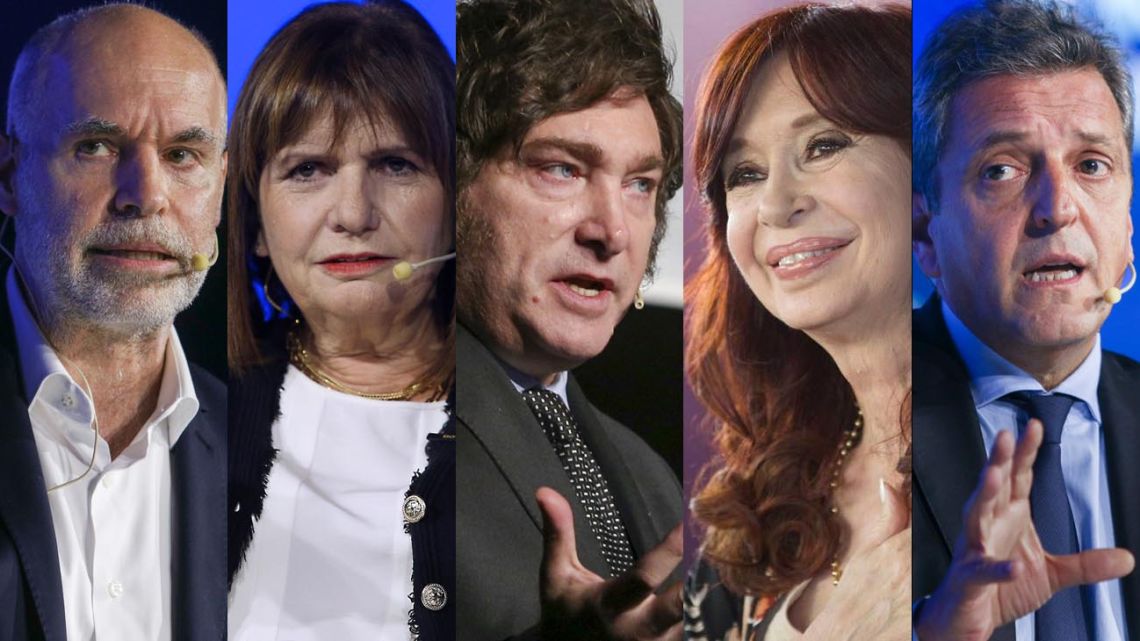

39 days after the closing of the lists, the political scene is in a state of total uncertainty regarding the presidents and two surveys suggested that there could be a three-way tie in the first round. according to Opinionthe order would be Together for Change, javier milei and the front of all. according to CELAGthe first place would be occupied by the libertarian, with pan-peronism as the second option.
The scenario of thirds or triple tie continues to be a fact that various consultants collect in opinion polls. I had marked it before Zuban Cordoba in two studies that charted the rise of Milei as a central figure of La Libertad Avanza. In this case, the two studies cited also concluded that the growth of the figure of the economist disarmed the bicoalitionist system that distributed the majority of the votes.
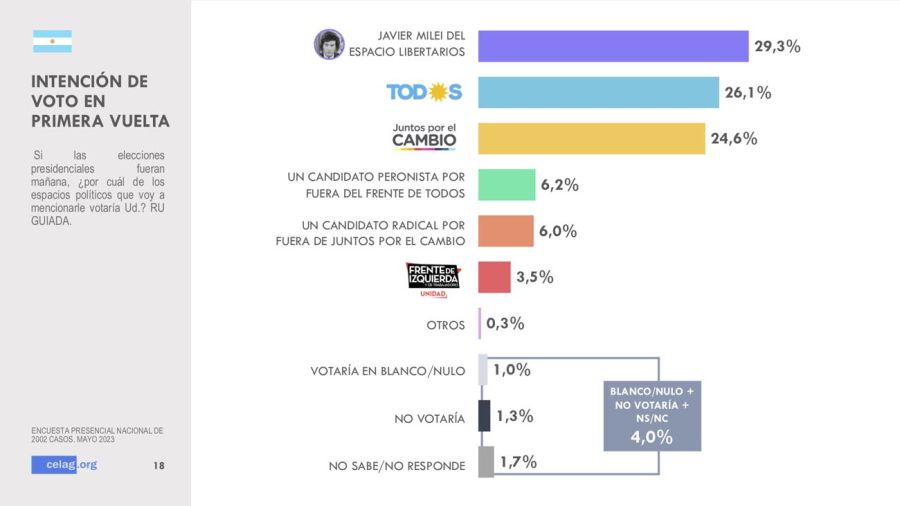
In the case of Latin American Strategic Center for Geopolitics (CELAG), it appeared that the intention to vote in the first round was higher for Milei (29.3%), then for the Frente de Todos (26.1%) and finally for Together for Change (24.6%). The other options were below 10%: “a candidate outside the ruling party” was elected by 6.2%, “a radical candidate from the opposition” by 6% and the Left Front by 3.5%. .
This thickening of Milei’s figure was heralded by Cristina Fernandez de Kirchner, who is also one of the leaders who reads the CELAG reports. In her last appearance at the Teatro Argentino, she produced a graph that explained what had happened to inflation in Ecuador after the dollarization of its economy. It was one of the many passages that she dedicated to the libertarian congressman, whom she raised to the ring of polarization.
The renowned political scientist Andrés Malamud stated in an interview with Francisco Olivera that in the primaries the applicants tend to polarize to ensure their core of voters, a strategy that is modified for subsequent competitions where they seek the undecided vote. In this case, not only Cristina Kirchner has transformed Milei into the “preferred enemy“, but also Together for Change, criticizing their positions.
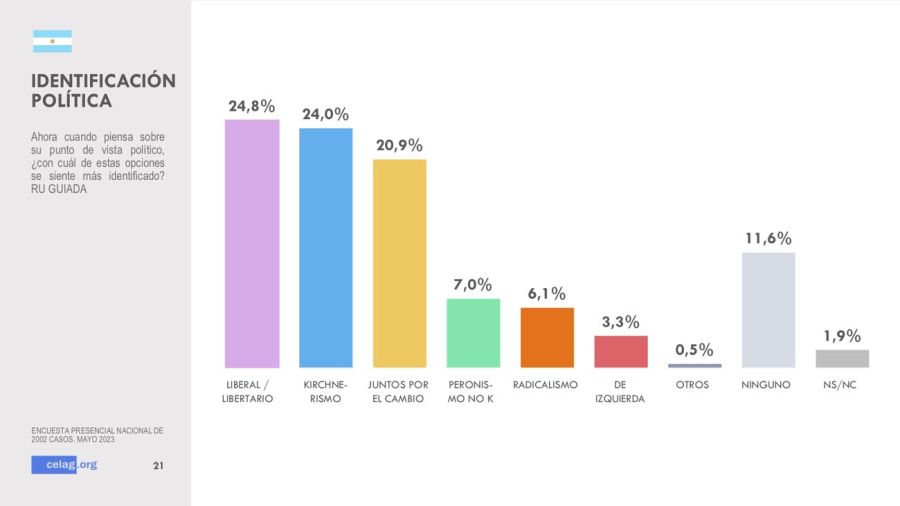
In another section, CELAG consults: “Now, when you think about your political point of view, which of these options do you most identify with? There, most of the responses are directed towards the “liberal/libertarian” option (24.8%), followed closely by 24% of the Frente de Todos. The podium is closed by Together for Change with 20.9%.
Another piece of information that emerges from the study is the battle with the possible internal ones in the official coalition and the feasible ones in the change itself. In the first, the one who prevails is Axel Kicillof and by a wide margin: he was chosen by 40.8% followed by Eduardo “Wado” De Pedro with 17.2% and Sergio Massa with 16.1%. Without defined pre-candidates, Peronist voters believe that the governor of Buenos Aires would be the most competitive and would also retain the wealth of Cristina Kirchner.
In Together for Change the scenario is different: not only are there different applicants but also two of them cut each other off. This is the case of Patricia Bullrich (41.5%) and Horacio Rodríguez Larreta (40.8%), both leaders of the PRO who seek to occupy the chair that Mauricio Macri already had as party representative. In this case, the former Minister of Security has an advantage.
The PRO is looking for a single candidate in CABA: this is what the surveys say about Jorge Macri and Fernán Quirós
What does the survey say that leaves Peronism third
The Opinaia survey obtained better numbers for Together for Change if the elections were held next Sunday. There the opposition space rose with 27%, followed closely with 26% by Javier Milei and 23% by the Frente de Todos.
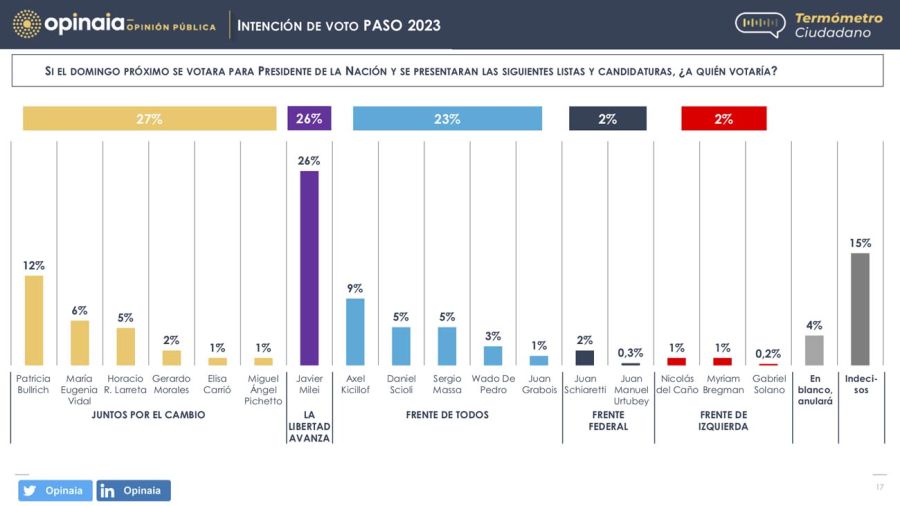
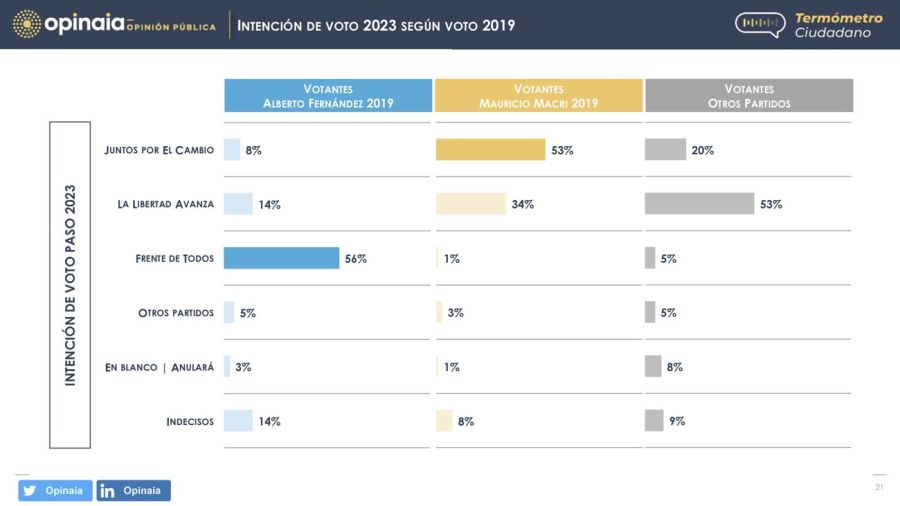
Regarding the primaries, the document indicates that 1 of 4 voters turned to the libertarian economist. “The vote for Javier Milei is a combination of a dissatisfied and angry electorate with the ruling class, with a certain hope (or curiosity) in relation to his proposals or ideas, especially in economic matters. In this sense, Milei manages to bring together not only opposition voters, who never voted for the Frente de Todos, but also a more independent electorate, who voted for Alberto Fernández in 2019, and today is disenchanted.”expanded in dialogue with PROFILE the consultant and public opinion manager of Opinaia, Guido Moscoso.
On the other hand, it clarifies that both the Frente de Todos and Juntos por el Cambio”They will only manage to retain just over 50% of their voters in 2019“, that is, that these votes migrated from party to party. That is why they affirm that Milei would receive angry voters from both coalitions, but also from former candidates such as Roberto Lavagna, Juan José Gómez Centurión and José Luis Espert.
The Opinaia survey was carried out between April 22 and 30, taking 2,000 national respondents as cases. The sample error was +/-2.2% with a confidence level of 95% and it was carried out online.
In the case of Celag, the surveys were face-to-face and covered a universe of 2,002 cases, with a confidence level of 95% and a margin of error of +/-2.2%. It was carried out between April 17 and May 7 in 27 locations in 18 Argentine provinces.
GI/fl
You may also like