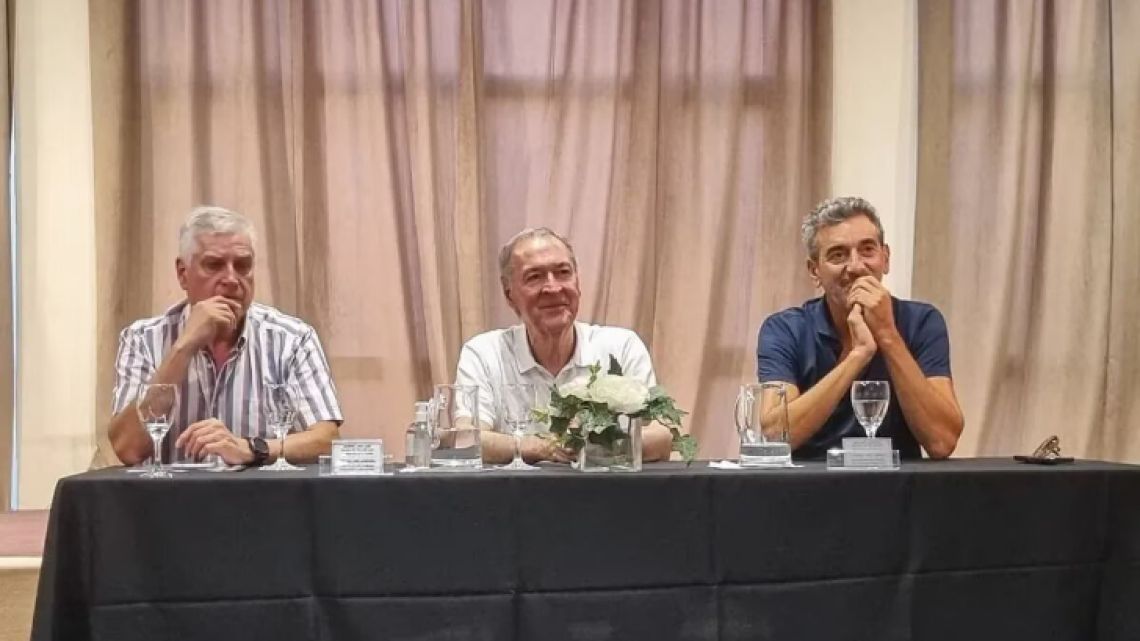

Governor Juan Schiaretti ended his presidential candidacy as a way to ensure his survival in politics, beyond December 10, and to avoid a taboo subject: concluding his term in the province, changing the “lame duck” syndrome, which speaks of the rulers who are nearing the end of their term with diminished power. In addition, the spirit of leading the country’s destiny is always present based on the management model that he launched together with his political partner, José Manuel de la Sota, in Córdoba. There’s no doubt about it.
Yesterday, its main swords -local and from other districts- were in the Federal Capital engaged in the definition of the payrolls, while the governor himself and his candidate for succession, the mayor of Córdoba, Martín Llaryora, finished agreeing on the list for the province of Córdoba, sharing the first two places.
The president is the political head of a bloc of three national deputies and a national senator and this year he will risk only one seat, that of Carlos Gutiérrez from Rio Cuarto. But he aspires to grow because he hopes that the ‘We do for Our Country’ front, if he finally gets 30 points, will place two parliamentarians in the Lower House.
National aspirations are linked to the appointment of Florencio Randazzo as running mate and to the presence of Hilda ‘Chiche’ González de Duhalde on the list of candidates for Buenos Aires deputies, to which we must add Diego Bossio as a candidate for governor for the Buenos Aires province.
Randazzo, according to almost all the surveys, has a not inconsiderable 5% of voting intentions in the province of Buenos Aires, but it remains to be seen if that electoral flow is transferred to the front in which he is running as a vice-presidential candidate.
However, yesterday optimism reigned in the ranks of Schiarettista Peronism because considering that the governor’s basket could grow before the decision of Kirchnerism to take Sergio Massa as presidential candidate.
It does not seem to be a reasonable hypothesis, but in the Civic Center they affirm that in the face of the anger and disappointment for having marginalized ‘Wado’ from Pedro and Juan Manzur in the final stretch, the Cordovan front can get a slice.
The goals. Schiaretti opted to continue in the center of the local scene and grow nationally. His central goals are three:
1-His obsession with not finishing the weakened mandate. That is why he fights to be the main voter and always show himself as the owner of the pen. The image of him as a maker and a winner could be increased today if Llaryora finally prevails in the provincial elections. Remember that he chose Llaryora, with whom he intended to establish a new political partnership similar to the one he built with José Manuel de la Sota, although the obvious situation is different.
He will continue to inaugurate works and show management until the last day of his term, because he is convinced that in this way he does not give up power and continues at the top. He is the center of everything and knows all the ways, as well as having most of the resources to make the structure work correctly.
2- Grow nationally and sit at the table of those who decide in Peronism. The 30 points – or something less – that he can add in Córdoba will allow him to broaden the parliamentary structure of Cordovan Peronism and its allies in the National Congress. Becoming a referee in certain circumstances is something that interests him and even amuses him. It already happened once this year, when Senator Alejandra Vigo concocted a plan that left Kirchnerism in the minority, which was celebrated as a goal in a World Cup.
Here we must also add an issue that not even their advisors, consultants and fellow travelers of recent times value or give the fair weight that the objective has: being part of the decision-making table.
What does that mean? To be somewhere highly anticipated within the National Justicialista Council, a body whose power has been liquefied in recent years because the first line of leadership ceased to obsess over it. Today, the head of the PJ is Alberto Fernández but there is no activity that breaks the mold.
Schiaretti is part of that old guard of Justicialism that sees the National Party Council as a governing body, from which all the functioning and organization of the party spills over. If they proposed him to lead the party, he would happily accept, there is no doubt about that.
3-Schiaretti chose Llaryora as his successor and that’s not new. Years ago he mentally selected him and the first strokes of this relationship must be found at the beginning of the 2000s, when De la Sota put a candidate in the internal for the current mayor of Córdoba. The current governor always supported him and almost silently gave him his support. This is a piece of information that should not be underestimated or left aside when analyzing the immediate and mediate future.
There are ideological and methodological coincidences that lead them to extol management as a starting point for any project and also a shared perspective on takeoff, growth and relationships that go beyond the borders of Argentina. There is personal affection, which is very important.
However, some doubts persist that do not go through Schiaretti, however, but through his second and third lines, where the fine tuning is not good because there is mistrust and jealousy. So, the schiarettistas fear that llaryorismo will become a train that takes everything. That’s what they think, that’s what they repeat, and that’s what they send to their political boss.
On the other side, Llaryora also tries to remain calm so that coexistence is not more complex than it was until recently. But here the last word belongs to the leaders and what they do to keep their second and third lines in box.