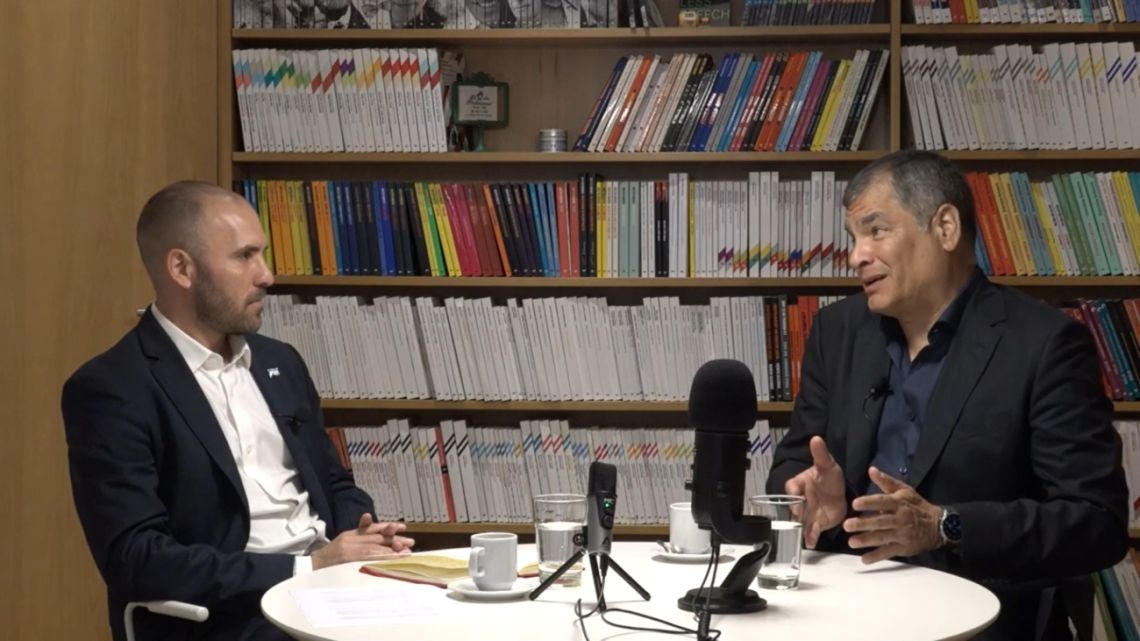

The former president of Ecuador, Rafael Correaparticipated in a cycle where he was interviewed by Martin Guzman and enumerated the characteristics of the problems of dollarize the economygiving as an example the country that governed between 2007 and 2017.
“They forget that any medication has side effects that can be much more serious than the primary problem. That is dollarization”, was one of the definitions left by the former Head of State who was convicted of corruption and disqualified from participating in politics for 25 years.
The discussion had as a background the proposal of the deputy javier milei to dollarize the Argentine economy, citing the Convertibility plan of the Carlos Menem government which, according to Correa, stimulated the Ecuadorian government at that time headed by Jamil Mahuad. Mahuad was precisely the president who discarded the sucre for the dollar in January 2000.
“We did quite well in our government. We grew more than the Latin American average, but the world must be clear that it was not thanks to dollarization but in spite of it”, Correa seemed to answer Guzmán’s questions for the cycle Dialogues for South America organized by the group of experts South America Vision.
Asylee in Belgium due to the sentence against him, Correa detected that dollarization decreased inflation but disrupted other indices. “Dollarization controls inflation and nothing else. But there are other problems, such as unemployment and industrialization. It solves an imbalance, in this monetary case, of inflation, but it generates others, combats unemployment or industrialization, which is basic for development, which should be our goal for the long term, ”he said.
“When convertibility collapsed and a great banking crisis took place in Ecuador, the Central Bank, to save the banks, which managed the economy, tripled the monetary issue, pulverized the national currency and came to the brilliant conclusion that the problem was not it belonged to the banks and economic power, but rather that Ecuadorians were genetically inferior to other nations and we could not handle a national currency and they imposed the dollar on us, which was even unconstitutional, until my government arrived,” he recalled.
A prestigious international economist, against the dollarization of Argentina
Correa spoke of four problems generated by dollarization
Throughout the hour and ten minutes of the interview, Correa listed four consequences that dollarizing the economy can generate to the detriment of their own currency. “The first is the need to give up the national currency, which is the main mechanism for social and economic coordination. Everyone knows that with credit and intelligent monetary issuance, the economy can be reactivated, ”he said first.
Secondly, he argued that the investment to import goods and machinery becomes an “Achilles heel” because underdeveloped countries do not produce them. “This creates problems in the external sector and they must be controlled, and the main instrument is the exchange rate,” he explained.
The economist who inspired Javier Milei calculated how much a salary can be worth if the economy is dollarized
After dollarization controls inflation but it does so with a high price level that made the country “very expensive” in relation to the region. “How does the industry compete against that? Because internal costs are much higher. And it begins to compete only based on natural advantages such as oil and soybeans, and it deindustrializes and other sectors that face external competition are depressed, for example the tourism sector, and you are left with a primary economy. It is very serious, ”he remarked.
Finally, he spoke of the subordination to the country that produces the currency. “You absolutely depend on the good or bad faith of the country issuing the currency. In good faith, when they have to apply monetary policies based on their interests and your economic cycles do not coincide with theirs”, he analyzed.
And he closed: “One needs to control inflation and they need to control the recession, (and therefore) they expand the supply of dollars and it generates more inflation for you. If the economic cycles do not coincide, there should be labor mobility with the country that issues the currency to avoid the real cost of that crisis”.
gi/ff
You may also like