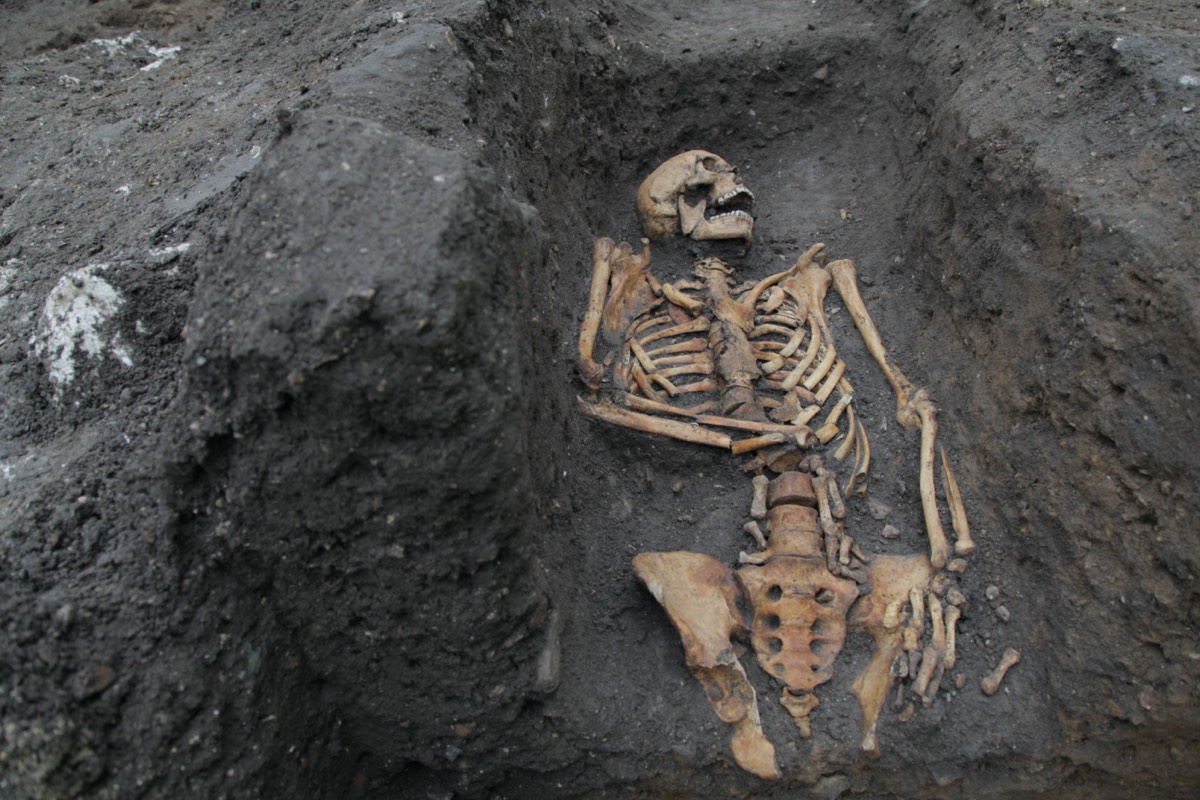

A significant archaeological find has been uncovered in central Poland, where a medieval knight’s remains were discovered underneath a location that used to be a well-known ice cream shop. This surprising discovery has piqued the interest of historians and locals alike, providing a unique insight into the area’s rich history and its ties to feudal Europe.
The uncovering took place amid regular renovation efforts in a town celebrated for its historic buildings and lively market scene. While laborers excavated beneath the edifice, they stumbled upon a stone sarcophagus lying far beneath the contemporary base. Further investigation revealed that the burial site had stayed undisturbed for hundreds of years, safeguarding not only an entire human skeleton but also numerous personal belongings.
Analysts studying the skeleton observed characteristics that matched those of a prominent medieval fighter. The remnants seemed to belong to a male, probably aged between 40 and 50 at the time of passing, with robust bones and evidence of healed wounds, implying a life full of physical challenges, typical of someone involved in warfare or knightly services. The placement of the skeleton, carefully positioned on its back with arms crossed, indicates a thoughtful and honorable burial, pointing to the individual’s esteemed rank in the community.
What stands out about this discovery is its remarkable location. It is situated right below what used to be a lively business—a quaint ice cream parlor well-loved by the community. This contrast between the ancient and the present shows how modern city life frequently overlays layers of historical importance, unseen by the casual observer.
Next to the skeleton, a number of relics were discovered, providing additional evidence of the man’s likely status as a knight. Near the body, there were parts of what could have been a sword handle, rusted chainmail fragments, and pieces of a belt clasp. Despite the corrosion over time, these objects are being meticulously preserved to gain insights into the artistry and material culture of that period. There is some conjecture that the grave could be from the 14th or 15th century, a time when Poland often participated in local battles, and knights were crucial in military and political spheres.
Archaeologists are currently engaged in careful efforts to record and protect the location. The procedure includes using ground-penetrating radar to explore the adjacent region, aiming to find any additional graves or items that may be close. Initial discoveries indicate that this might be a section of a neglected cemetery, which could be linked to a historical church or military station that once existed in the vicinity.
The existence of a burial site beneath a business establishment isn’t particularly unexpected in European cities, where modern development frequently builds on centuries-old history. Nevertheless, fully intact skeletons in such excellent condition are quite uncommon. Experts suggest that the burial’s untouched state might have been maintained due to the continuous building on the location, which unintentionally shielded it from environmental effects and human activity over time.
The recent finding has rekindled community excitement about the town’s medieval past. Locals, most of whom did not know about the region’s significant historical background, have shown both surprise and pride in the discovery. Discussions are underway to incorporate the site into local educational and cultural projects. Some propose establishing a small display area in the town center where people can discover more about the knight’s life and the era he lived in.
Local authorities are also collaborating with historians to piece together the identity of the knight. While records from that era are sparse and often incomplete, efforts are underway to examine archival documents, family crests, and other genealogical clues that may provide a name or lineage. If successful, this could add a human story to the skeleton—transforming the find from a fascinating curiosity into a tangible link to Poland’s medieval past.
The broader implications of the discovery go beyond one individual. It serves as a reminder of the ever-present history that underpins daily life in Europe, where the past and present coexist in often unexpected ways. It also emphasizes the importance of careful archaeological procedures during modern development, especially in regions known for their historical significance.
In the next few months, the restoration and research teams aim to present more comprehensive results regarding the knight’s background, way of life, and reason for death. Genetic testing might reveal information about his lineage, medical conditions, or physical attributes. Alongside the examination of the burial artifacts and methods, these studies might contribute to a more complete understanding of this individual and his place in medieval Polish society.
At present, what used to be a lively ice cream shop has transformed into a bustling archaeological site—calm, careful, and brimming with wonder. It serves as a reminder that beneath even the most mundane places, amazing stories frequently await discovery.