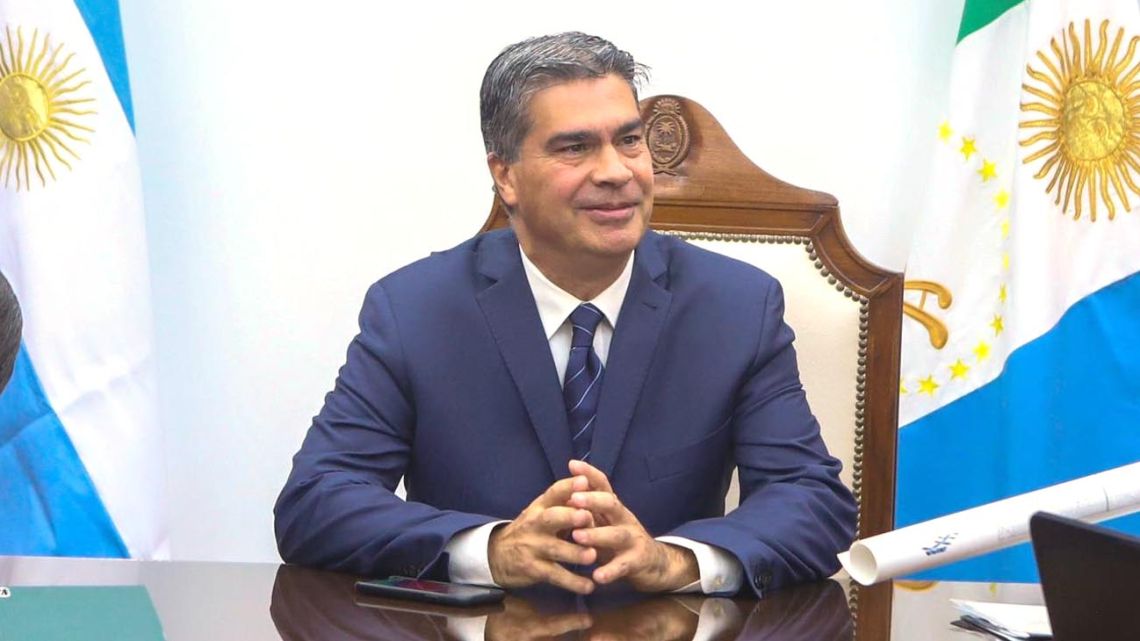

The governor of the province of Chaco, Jorge Capitanich, strongly criticized the actions, in recent times, of the Supreme Court of Justice of the Nation. “We have a partial Supreme Court of Justice, which favors a political unity and which has violated the following articles of the partial National Constitution: 99 paragraph 4, when they agree to be appointed by decree of the National Executive Branch; article 1, when it interferes in the attributions of other powers, when it violates the federal principle of government and when it defines the representation of Congress and article 16 of equality before the law that must be guaranteed for all citizens,” he said. And he added: “There is no doubt that the combination of concentrated, corporate-based economic power, together with the construction of meaning based on a concentrated media model financed by these power groups co-opting the judiciary for the propagation of “soft blows” configure the new matrix of the validity of ‘democratic reductionism’.
Capitanich affirms, based on a historical reconstruction, that the current formation of the highest court responds to a “misogynistic, centralist and corporate representation of economic power” logic. “During 160 years of history, starting with Law 27 in 1862, the formation of the Supreme Court of Justice involved 113 judges, the majority coming from the Province of Buenos Aires -including CABA-, Córdoba and Santa Fe (75% ), expressly excluding 11 provinces,” he mentioned. And he added: “From 1862 to 1930 the President of the Court was appointed by the President of the Republic and in exchange for the fall of September 10, 1930, where “the doctrine of de facto governments” was instituted, the President of the Court they choose it among its members. The Attorney General of that Court made up of José Figueroa Alcorta, Roberto Repetto, Ricardo Guido Lavalle and Antonio Logoma was Horacio Rodriguez Larreta, grandfather of the current head of government of the City of Buenos Aires”.

In his analysis, the governor of Chaco highlighted the figure of Néstor Kirchner, who in his role as President of the Nation and through decree 222/2003, “promoted the holding of public hearings for the appointment of its members with a criterion of transparency in tax and patrimonial matters, present parameters of specialty in the matter, gender perspective and federal origin”. And he added: “In contrast, Mauricio Macri appointed two of its members by decree, who accepted it, violating the procedure established by decree 99 paragraph 4 of the National Constitution together with the appointment of 211 judges, prosecutors and defenders for the Federal Justice and National.
For Capitanich, “it is essential to promote rules in the construction of a republican system of government with division of powers, which implies: expansion of the members of the Supreme Court of Justice through background contests, opposition and public hearing as in the Province of Chaco , promote structural reform in the integration of the Council of the Magistracy, ratify a healthy principle of social solidarity with the implementation of the income tax for judges, establish the regulation in the mandate of judges to establish a system of renewal by judicial career in lower courts through judicial school and open competitions in the highest bodies of representation and transparency in the administration of the resources of the Judiciary”.
You may also like