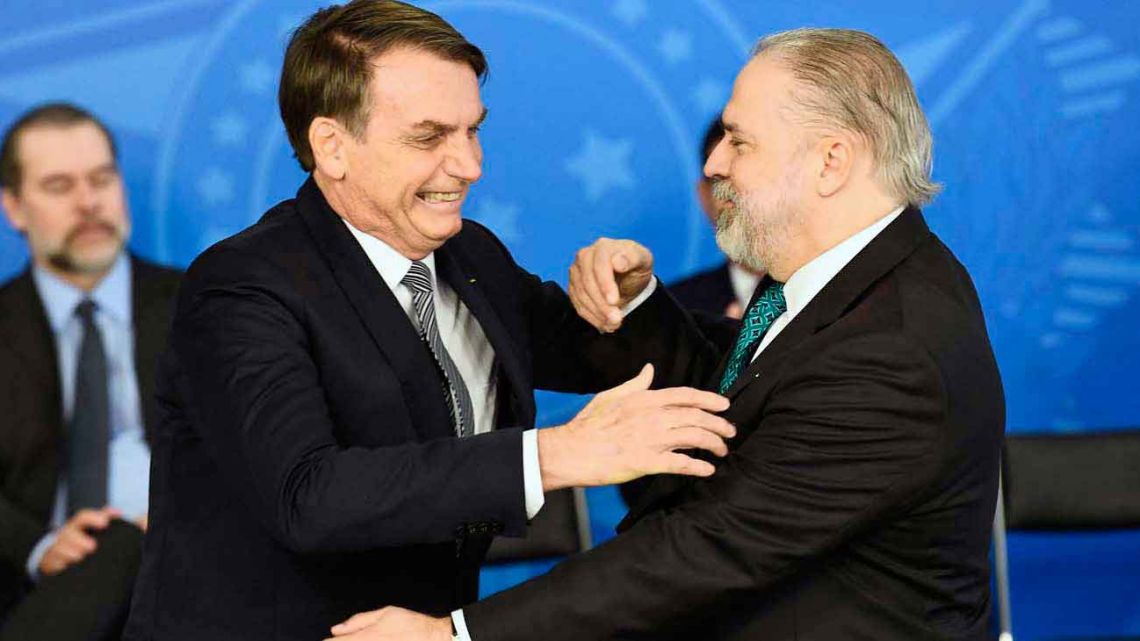


There is a consensus among Brazilian political analysts that Augusto Aras, the current attorney general, has had a disastrous performance, to say the least. Instead of fighting the excesses of Jair Bolsonaro and his environment, the head of the Federal Public Ministry would have been an accomplice of the now former president. Although the diagnosis is correct, the explanation of why it behaved like this will usually be incorrect.
Attributing to Aras an ideological alignment with Bolsonarismo, or even a kind of deviation of character, is inaccurate and difficult to prove, in addition to not explaining the apparent change of position that the prosecutor will change after the election of Luiz Inácio Lula da Silva in 2022 The way to make the appointment and, above all, the possibility of renewing the two-year term are the points in which the key to understanding the behavior of the attorney general is found. And not only of this one, but also of the others who have passed through the position. Aras is above all a careerist, but not always a man of the extreme right.
Augusto Aras, like his predecessors, followed the rules of the game. Rachel Dodge, appointed by Michel Temer in 2019, only authorized cases against Bolsonaro when she no longer had a chance of being reappointed as head of the Attorney General’s Office by the new president, according to the press. Rodrigo Janot, for his part, worked during his two terms in favor of the interests of his colleagues in the Federal Public Ministry, when they were the ones who would choose the attorney general (Lula and Dilma Rousseff almost automatically accepted the appointment of the one most voted for by their own members of the body). Geraldo Brindeiro, who was appointed and re-elected three more times by Fernando Henrique Cardoso, became known as the “general filer of the republic” for filing many accusations against the government.
Aras has opened fewer corruption cases than his predecessors
With his sights set on his candidacy in 2018, Aras did not participate in the election organized by federal prosecutors, because he knew that Bolsonaro would not listen to the wishes of the corporation. By seeking his re-election in 2021, the attorney general was able to show that he was quite careful with the then president, even being considered by Bolsonaro himself for a future vacancy on the Federal Supreme Court (STF).
Aras barely bothered Bolsonaro until the results of the polls were known in 2022, still hoping that the pen of the then president could reach the STF or another period at the head of the Public Ministry of the Union. Now, with a new president and no chance of keeping important posts, he is trying to clean up his worn-out screen a bit by acting against the terrorists who attacked Brazilian democracy this year. Shame is what remains of Aras’s reputation.
The current Attorney General defends himself by saying that it is not true that he would have protected former President Bolsonaro. He remembers that he acted in some cases, but that he avoided the politicization of the times of the Lava Jato operation. The partial numbers of his performance, however, do not seem to support this position. The attorney general filed several complaints that the president had acted criminally in the management of the covid-19 pandemic, which were presented by the Parliamentary Investigation Commission (CPI) of the Senate.
During the 2022 electoral campaign (the most violent since redemocratization in 1985 and which was marked by the use of fake news by Bolsonaro’s allies), Aras, who is also electoral general attorney, did not use the Electoral Justice in any occasion on the use of lies and fake news, according to a report by Folha.
A Transparency International investigation shows that it has opened fewer corruption-related criminal investigation procedures (CIPs) than its predecessors. In 2016, still with Rodrigo Janot as attorney general, there were 577 PICs. With Aras, these figures dropped to 366 in 2019, two hundred in 2020 and 241 in 2021. The STF and its ministers had to adopt unorthodox measures to overcome the inertia of whoever holds the monopoly on criminal prosecution in relation to the president, the ministers and parliamentarians.
Aras’ term ends in September. Lula did not promise to respect the election organized by federal prosecutors (and he did so with good reason). The experience of a federal prosecutor who has his own colleagues as constituencies was also disastrous. Janot, who headed the Federal Public Ministry during the Lava Jato operation, did as much damage to Brazilian democracy as Aras.
We must end a long quarantine for those who occupied the Attorney General’s Office
And the question is not, however, the political position of both. The problem is that the possibility of being reappointed to the position or occupying other prominent positions in the Brazilian State, such as a minister of the STF, encourages the attorney general to act in a way that may require improper action.
When a president appoints and reappoints the attorney general without consulting the members of the Federal Public Ministry, as Fernando Henrique Cardoso and Bolsonaro did, we are witnesses of occupants of the Attorney General’s Office, who are excessively lenient with the heads of the Executive.
When, on the other hand, the power of appointment is lost to the 1,200 public prosecutors, as Lula and Rousseff did, we run the risk of having a very powerful office holder with no political limit other than his own corporation.
It is necessary to end the possibility of re-election and the creation of a long quarantine for those who occupied the Attorney General’s Office. Otherwise, Brazil will always return to the same dilemma from time to time: excessive independence or lack of autonomy, two extremes that are detrimental to democracy.
*Professor at the Federal University of the State of Rio de Janeiro (Unirio).
PhD in Political Science, from the University of São Paulo (USP) (Latin America 21).
You may also like