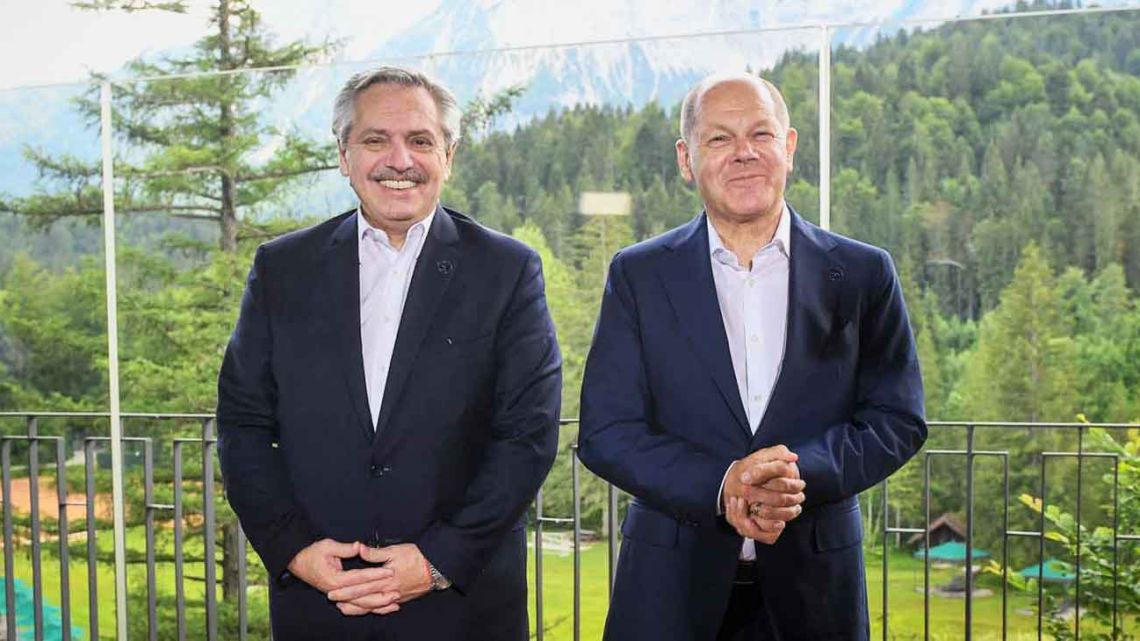


In the context of an increasingly multipolar and volatile international ordering, the pending issues of world politics are becoming increasingly important: global challenges such as climate change, pandemics, peace, migration, digitization and new wars demand more political attention and better capacity for action.
The visit of German Chancellor Olaf Scholz to Argentina (and Brazil and Chile) is an excellent opportunity to rethink European-Latin American relations in general. Since the fall of the Berlin Wall, bi-regional ties have lost relevance and intensity: the distances seem to increase to the detriment of both parties. The contradictions of geopolitics, especially during the covid-19 crisis, have shown the absence of solidarity and scant multilateralism between Europe and Latin America. However, it is worth noting the image of Germany in Argentina: an extremely crucial piece of information to rethink the reactivation of binational relations. According to a Latinobarómetro survey (Germany is, for Argentines, the country with the best opinion compared to the US, China, Russia, Iran, Israel, Great Britain, Spain or France.
It should be noted that currently the democracies of Europe and Latin America share an eloquent common problem: the rise of violent extremism from the right, which is subjecting our democracies to disturbing and unusual pressure. What leaders on both sides of the Atlantic share is that, despite their differences, they need to find answers. The question of how to broaden, deepen and protect democracy is identical in Europe and Latin America: it is a question, then, of increasing dialogue and exchange between both regions in conditions of frankness and symmetry. In a world in which upcoming wars and the rise of authoritarianism condition European foreign policy, alliances of partners oriented by democracy, peace and multilateralism are not only useful, but necessary.
The visit of German Chancellor Olaf Scholz is a significant signal to reactivate ties with Argentina (and with the Southern Cone) in a more comprehensive sense, just on the 40th anniversary of democracy. In addition to greater cooperation in the area of renewable energy and in commercial matters of reciprocal interest, dynamic and innovative socio-political relations are required to strengthen resilience, plurality and rights in our democratic societies. Why are there radical and extreme voices that reject the existing democratic model? And this happens in Germany like Argentina, in France like Brazil, despite the different economic and welfare levels. The social dimension is a fundamental factor for the survival of democracies. On both sides of the Atlantic we can see how the social fabric of our societies is cracking, how people with a paid job do not survive on a monthly basis and are increasingly pushed to the margins of survival, without being heard in their opinions and aspirations. Consequently, not only governments, but also non-state actors and citizen movements on both sides are called to reactivate initiatives and actions, whether in minilateral, multilateral or bi-regional spaces.
The starting point for a revived sociopolitical relationship between Argentina and Germany, between Latin America and Europe is encouraging: the European Union and the values it continues to represent are attractive to Argentine and Latin American society; especially when it comes to “soft power” issues such as human rights, climate change and the fight against poverty. Despite the limited perception of the soft power of the EU, it is precisely this sphere, and the issues associated with it, that are most pressing on the international scene. Problems such as inequality, injustice, extreme poverty, human rights violations and environmental deterioration are the main concerns of all of Latin America. The survey makes it clear that the veracity of European foreign policy is based on its model of social cohesion based on co-responsibility and pluralism and that Latin America, as a whole, prefers the European development model to others.
Alliances and partners must be cultivated and, above all, that they feel seen as equals and treated fairly. Europe should take better advantage of the potential contained in its relations with Argentina and the other countries of the Southern Cone. If the EU does not do so, other powerful players will step in based, among others, on their technological might. Europe must understand the opportunities offered by the association with Latin America, and not just repeat the many problems of the region. To do this, however, we have to offer Latin America more alternatives to be attractive and effective. Matters related to the development model, investment and trade links should not be left solely in the hands of the private sector. Cooperation in health, science, strategically relevant areas of industry and agriculture and the new sectors around renewable energy must be intensified and communicated intelligently.
Furthermore, and very importantly, Argentina and Germany can be partners, especially in matters of human rights and the search for peaceful solutions because they share – each one in its context and with its specificity – traumatic collective memories of the 20th century. The culture of memory of both countries is important and exemplary. It can diplomatically contribute to strengthening human rights, promoting the peaceful settlement of disputes and even global denuclearization.
For all of the above, it is possible to conceive new concrete initiatives. At this time, for example, Germany and Argentina could promote, in conjunction with other countries in Europe and Latin America, an ideal that transcends the current realpolitik. It is the moment of the geoenvironmental; This is from a productive development mode based on innovation and environmental and social responsibility. In addition, at a time when the multilateral aspect seems to be weakening, it would be valuable to stimulate a sort of North South Atlantic alliance –for this case, Argentina, Brazil, Chile, Uruguay, Germany, Spain, France and the Netherlands– for peace and multilateralism with a scheme of periodic consultations every six months. We are convinced that there is room (and urgency) to make specific and achievable commitments based on shared and complementary interests.
*Representative of the Friedrich Ebert Foundation (FES) in Argentina. Director of the magazine Nueva Sociedad.
**Vice Chancellor of the Torcuato Di Tella University.
You may also like